

What is topical authority?
Topical authority is how strongly search engines and AI answer engines recognize a website as a reliable, expert source on one subject. A site earns it by covering the subject completely and linking related pages into clusters, with real expertise on every page. That site then becomes a strong candidate for queries across the whole topic instead of a single keyword.
The term is an industry concept, not a single score Google publishes. Google has confirmed one system with a similar name for news, and its broader documentation rewards the same things practitioners mean by topical authority: depth, a clear site focus, demonstrable expertise, and trust. This guide separates what Google has stated from what is practitioner method, so your team can explain the difference to clients.
Explore the Topical Builder features to see how the platform helps you plan topic clusters, identify content gaps, audit existing pages, prioritize improvements, and build a structured topical authority strategy.
Key takeaways
- Topical authority is earned by complete, connected, expert coverage of a topic. It is not a metric you can look up in Search Console.
- Google confirmed a “topic authority” system in 2023, but it applies to news queries. For general web search, the closest official guidance is Google’s people-first content and E-E-A-T documentation.
- Google says its ranking systems work mainly at the page level, but site-wide signals also feed in. That is why a focused site often outranks a broader site on the same subject.
- Measure it as coverage: which subtopics your site covers well, covers weakly, or misses, compared with what actually ranks for the topic.
- Build it in order: define the topic, map it from search data, audit your coverage, prioritize gaps, publish in clusters, link the cluster, then refresh.
- AI answer engines retrieve across many related subtopics for one question. Complete clusters give them more citable passages from your site.
- Mass-producing thin pages to look comprehensive breaks Google’s scaled content abuse policy. Coverage has to come with original value.
Does Google use topical authority as a ranking factor?
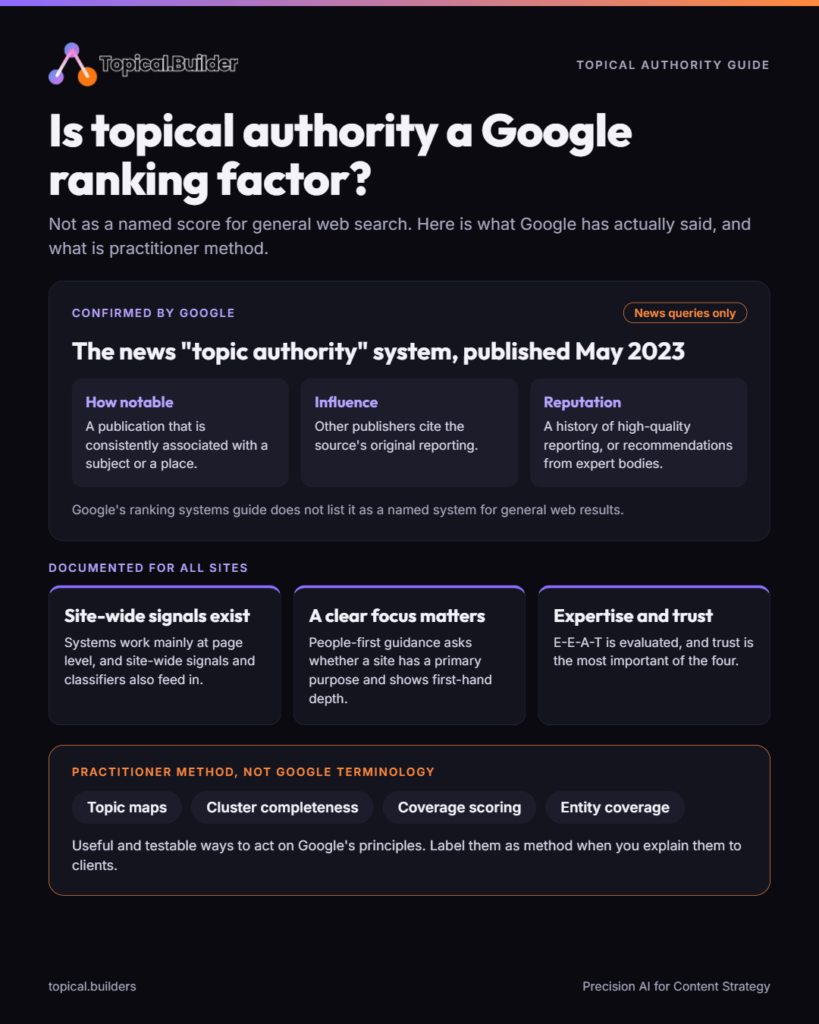
Google has not published a site-wide “topical authority score” for general web search. It has confirmed a system called topic authority for news, and it has documented several principles that produce the same result for every kind of site. SEO teams should know which statements are official so they don’t overstate them to clients.
What Google confirmed: the news topic authority system (2023)
In May 2023, Google Search Central published “Understanding news topic authority.” It describes a system that helps decide which expert sources are helpful for news queries in specialized areas such as health, politics, or finance. The most prominent signals Google named were:
| Signal Google named | What it means in practice |
|---|---|
| How notable a source is for a topic or location | The publication is consistently associated with that subject or place |
| Influence and original reporting | Other publishers cite the source’s original work |
| Source reputation | A history of high-quality reporting, or recommendations from expert sources such as professional societies |
The scope is news. Google’s guide to Search ranking systems does not list “topic authority” as a named system for general web results. Do not tell clients that Google applies this exact system to a SaaS blog or a dental site.
What Google documents for all sites
Three official statements explain why focused, complete sites tend to win across a topic.
- Site-wide signals exist. Google’s ranking systems guide says its systems are designed to work at the page level, and that site-wide signals and classifiers also contribute to its understanding of pages. Good site-wide signals do not guarantee every page ranks, and weak ones do not sink every page.
- A clear focus matters. Google’s guide to creating helpful, reliable, people-first content asks whether a site has a primary purpose or focus, and whether content shows first-hand expertise and depth.
- Expertise and trust are evaluated. The same page describes E-E-A-T (experience, expertise, authoritativeness, trustworthiness) and states that trust is the most important of the four.
What is practitioner method
Topic maps, cluster completeness, coverage scoring, and entity coverage are methods SEO teams use to operationalize those principles. They are useful and testable. They are not Google terminology, and this guide labels them as method.
Key terms
- Topic: a subject a searcher needs understood as a whole, such as “topical authority” or “dental implants.”
- Subtopic: a distinct question or task within a topic, which usually deserves its own page.
- Entity: a uniquely identifiable thing or concept (a person, organization, product, or idea) that search systems can recognize and relate to other entities.
- Topic cluster: a pillar page plus the supporting pages that cover its subtopics, connected by internal links.
- Topical map: a structured plan of every topic and subtopic a site should cover, with intent and priority for each.
- Coverage: the share of a topic’s subtopics a site addresses well enough to compete.
Why does topical authority matter for SEO and AI search?
Topical authority matters because both rankings and AI citations favor sources that answer the full set of related questions with demonstrated expertise. A site with one strong page competes keyword by keyword. A site with a complete, connected cluster competes for the topic.
How Google evaluates topical expertise
Google does not publish a formula, but its documentation points to the inputs SEO teams can influence.
| Input | What Google says | What your team controls |
|---|---|---|
| Page relevance and quality | Ranking systems work mainly at the page level | Intent match, depth, original insight on every page |
| Site-wide signals | Site-wide signals and classifiers contribute to understanding pages | Site focus, consistent quality, pruning off-topic or thin pages |
| Expertise and trust | People-first content guidance asks about first-hand expertise; trust is the most important part of E-E-A-T | Named authors, credentials, clear methodology, accurate claims |
| Links and references | Link analysis systems and PageRank remain part of core ranking | Earning citations to original work; internal links between related pages |
| Passages | A passage ranking system can identify relevant sections within a page | Self-contained sections with question-style headings |
Google’s Search Quality Rater Guidelines give raters the same lens. Raters judge E-E-A-T and the reputation of a site and its content creators. Rater scores do not directly change rankings, but they show what Google’s systems are designed to reward.
How AI answer engines use topical coverage
Google’s documentation on AI features and your website says AI Overviews and AI Mode may use query fan-out: issuing multiple related searches across subtopics to build one response. A single user question can therefore pull passages for several subtopics at once.
That has two practical consequences for SEO teams:
- A site that covers the subtopics a fan-out explores has more passages eligible to be cited for the same question.
- Google states there are no extra requirements to appear in AI Overviews or AI Mode. A page must be indexed and eligible to show a snippet, and standard SEO practice applies. No special AI text file or schema is required.
Other answer engines publish less about how they select sources. The safest working assumption is the same one: retrieval favors pages that are indexed, clearly structured, and answer the question directly. The AI search optimization guide covers engine-by-engine practice.
What a site with topical authority looks like
- Every important subtopic has one page that owns it, with no two pages competing for the same intent.
- A pillar page links down to every supporting page, and each supporting page links back up and across to its siblings.
- Terminology is consistent site-wide, so the same entity is never called three different names.
- Authors are named and their expertise is visible.
- Content is refreshed when facts, products, or guidelines change.
Topical authority vs domain authority: what’s the difference?
Topical authority describes how well a site covers and is trusted on one subject. “Domain authority” usually refers to third-party link-based scores that estimate a domain’s overall strength. Google does not use any third-party authority score. A smaller site with deep coverage of one topic can outrank a far larger site whose coverage of that topic is thin.
| Topical authority | Link-based domain scores | |
|---|---|---|
| What it describes | Expertise and coverage on a specific topic | Estimated overall link strength of a domain |
| Scope | One topic or cluster | The whole domain |
| Main inputs | Coverage, content quality, internal structure, expertise, topic-relevant citations | Volume and quality of inbound links |
| Used by Google? | Not as a named score; reflects principles Google documents | No. These are third-party estimates |
| How a team improves it | Map gaps, publish and link clusters, show expertise | Earn links |
| Best use | Planning content and explaining relevance to clients | Rough competitive benchmarking |
The two interact. Links from sources relevant to your topic support both, while links from unrelated sites do little for topical relevance.
Topical depth vs breadth
Depth is how thoroughly you cover each subtopic: definitions, how-tos, examples, mistakes, comparisons, metrics, and FAQs. Breadth is how many adjacent subtopics you cover.
The working rule: go deep before going wide. One nearly complete cluster gives search engines a coherent body of evidence on a topic. Three partial clusters give them three thin signals, and none answers the full set of questions searchers ask. Expand into an adjacent topic when it shares entities and audience with the core, and when your current cluster has no high-priority gaps left.
A dental practice illustrates the point. Covering dental implants completely (candidacy, procedure stages, recovery, costs, risks, alternatives, aftercare) builds authority on implants. Adding one page each on orthodontics, cosmetic bonding, and sleep apnea spreads effort and builds authority on none of them yet.
How do you measure topical authority?
You measure topical authority indirectly, as coverage plus performance. First, define the topic’s full set of subtopics from what actually ranks. Then mark each one as covered, weakly covered, or missing on your site. Finally, track whether impressions, rankings, and AI citations broaden across the cluster over time.
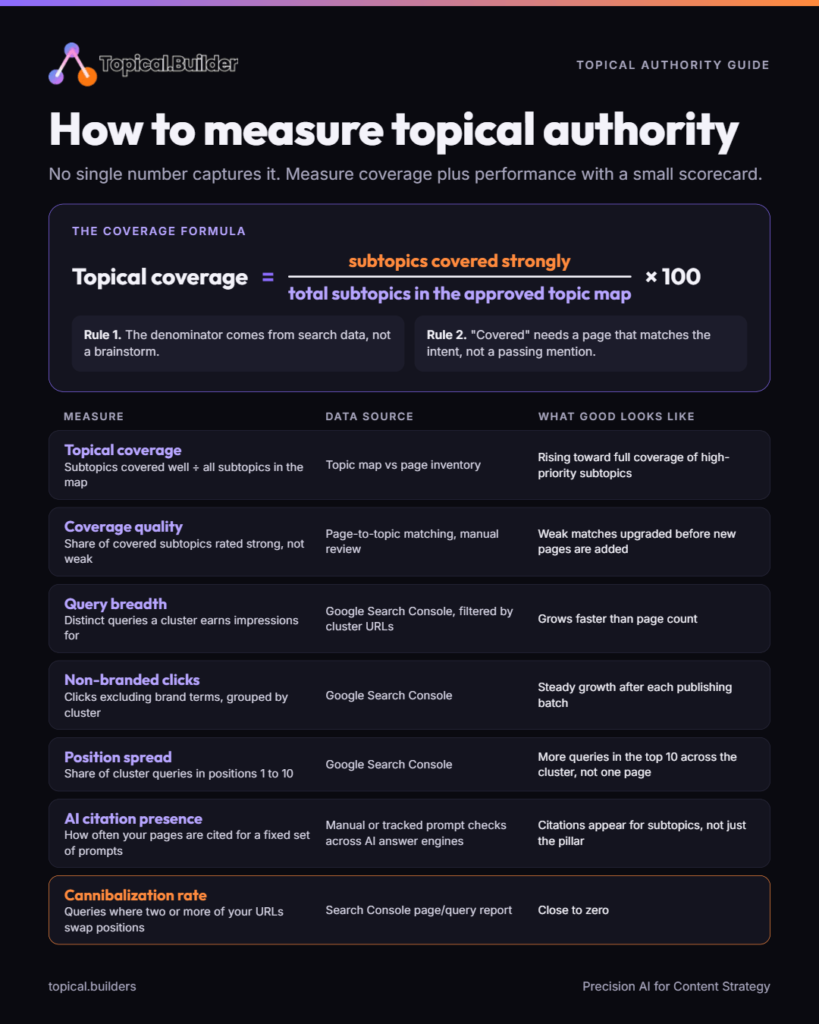
No single number captures it. Use a small scorecard instead.
| Measure | How to calculate it | Where the data comes from | What good looks like |
|---|---|---|---|
| Topical coverage | Subtopics covered well ÷ total subtopics in the topic map | Your topic map vs your page inventory | Rising toward full coverage of high-priority subtopics |
| Coverage quality | Share of covered subtopics rated strong rather than weak | Page-to-topic matching, manual review | Weak matches upgraded before new pages are added |
| Query breadth | Count of distinct queries a cluster earns impressions for | Google Search Console, filtered by cluster URLs | Grows faster than page count |
| Non-branded clicks per cluster | Clicks excluding brand terms, grouped by cluster | Google Search Console | Steady growth after each publishing batch |
| Average position spread | Share of cluster queries in positions 1 to 10 | Google Search Console | More queries move into the top 10 across the cluster, not one page |
| AI citation presence | How often your pages are cited for a fixed set of topic prompts | Manual or tracked prompt checks across AI answer engines | Citations appear for subtopics, not just the pillar |
| Cannibalization rate | Queries where two or more of your URLs swap positions | Google Search Console page/query report | Close to zero |
Topical coverage as a single figure:
\text{Topical coverage} = \frac{\text{subtopics covered strongly}}{\text{total subtopics in the approved topic map}} \times 100
Two rules keep the scorecard honest. The denominator must come from search data, meaning the subtopics pages that rank actually cover, not from a brainstorm. And a “covered” subtopic needs a page that matches the intent, not a passing mention inside an unrelated post.
Measuring coverage with Topical Builder
Building the denominator by hand means searching every seed query, reading the top pages, and extracting their subtopics and entities. Topical Builder automates that step. Its Reference Map takes seed queries for an industry, checks what ranks on Google, crawls the top pages, and extracts entities to build a structured topic map. Every subtopic traces back to a ranking page, and the map is versioned and approved before use. It then matches your crawled pages to each topic as a weak or strong match and marks every topic covered, weak, or missing.
How do you build topical authority? An 8-step workflow
Build topical authority by mapping your topic using search data, auditing your existing content, and improving weak pages before creating new ones. Then publish complete content clusters connected to a central pillar page. Repeat the audit after each publishing batch to identify gaps and opportunities.
The steps below outline a repeatable workflow agency teams can use for any client. Explore how Topical Builder works to understand the process, with each step linking to a detailed guide.
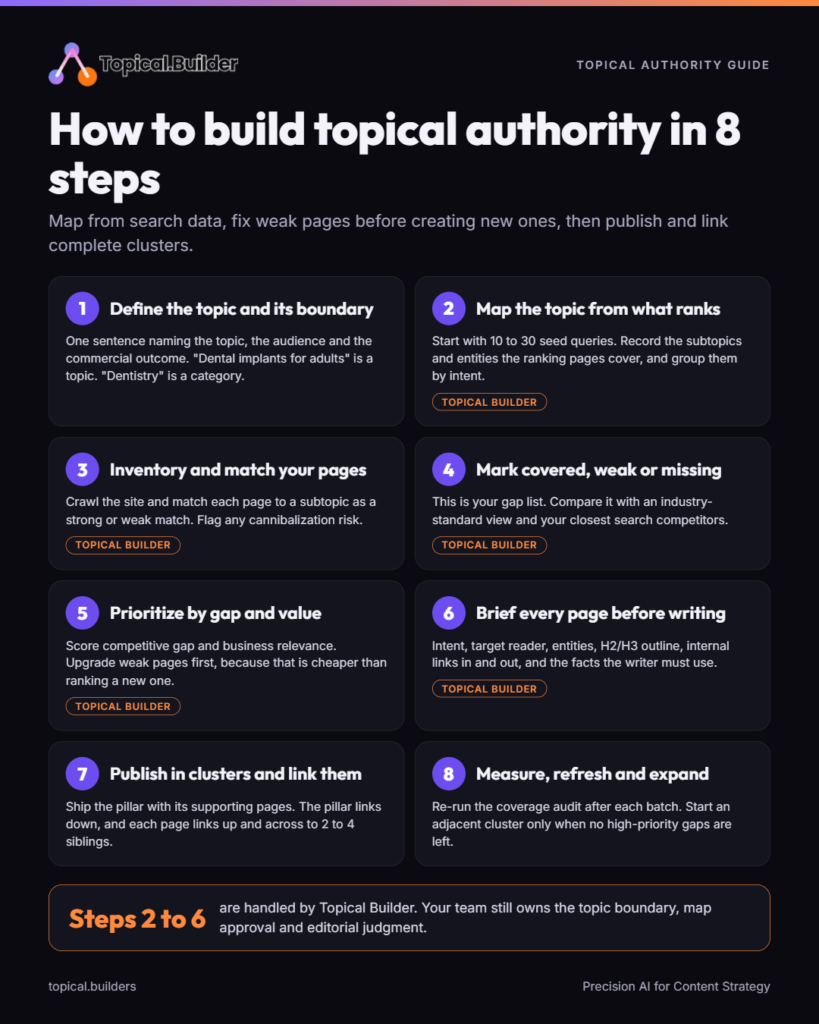
- Define the topic and its business boundary. Write one sentence naming the topic, the audience, and the commercial outcome. “Dental implants for adults considering tooth replacement in Toronto” is a topic. “Dentistry” is a category. The boundary tells you which subtopics are in scope and which belong to a future cluster.
- Map the topic from what ranks. Start with 10 to 30 seed queries, review the pages that rank for them, and record the subtopics and entities those pages cover. Group subtopics by intent. The output is a topical map: every subtopic with its intent, primary entity, and proposed page type.
- Inventory and match your existing pages. Crawl the site and match each page to a subtopic. Record whether each match is strong (the page owns that intent) or weak (it only touches the subtopic). If two pages compete for one subtopic, flag it as a keyword cannibalization risk.
- Mark every subtopic covered, weak, or missing. This is your gap list. If you can, compare it against two benchmarks: an industry-standard view of the topic and your closest search competitors. The content gap analysis guide explains both.
- Prioritize by gap and business value. Score each subtopic on competitive gap (how far behind you are) and business relevance (how close it sits to revenue). On high-priority subtopics, fix weak pages first, because upgrading a page is cheaper than ranking a new one. The content prioritization framework has a scoring sheet.
- Brief every page before writing. A brief states the intent, the target reader, the primary and related entities, the H2/H3 outline, internal links in and out, and the facts the writer must use. Briefs are how a team keeps quality consistent when it publishes at volume.
- Publish in clusters and link them. Where possible, ship a pillar and its supporting pages together. The pillar links down to every supporting page. Each supporting page links up to the pillar and across to two to four siblings, with descriptive anchor text.
- Measure, refresh, and expand. Re-run the coverage audit after each batch and refresh pages whose facts or rankings have slipped. Start an adjacent cluster only when the current one has no high-priority gaps left.
What each page in a cluster needs
| Page element | Why it matters for topical authority |
|---|---|
| One clear intent | Prevents cannibalization and makes the page the obvious owner of its subtopic |
| A direct answer in the first 40 to 60 words | Gives search and AI systems a quotable passage |
| Question-style H2s and H3s | Mirror real queries and support passage-level retrieval |
| Defined entities | Consistent names and definitions help systems connect pages to the same topic |
| First-hand detail | Workflows, examples, and failure modes are the expertise Google’s guidance asks for |
| Named author with visible expertise | Supports the “who” in Google’s E-E-A-T guidance |
| Sourced facts | Every statistic carries a source and year, which supports trust |
| Links to pillar and siblings | Shows the cluster structure and moves users through it |
| Structured data where it fits | Article, FAQPage, or Organization markup clarifies what the page is and who published it |
Where Topical Builder fits in this workflow
Topical Builder handles steps 2 to 6. It builds the Reference Map from ranking pages, crawls and matches your site, and scores each topic’s priority as 50% competitive gap and 50% business relevance. It can also compare your site against an Industry Standard Relevance Map and a competitor map. For each gap, it generates a brief with title, intent, headings, key entities, and internal link suggestions. Optional content drafts are grounded in a Fact Vault of verified facts, a brand voice profile, and client include/exclude rules. Your team still owns the topic boundary, the approval of the map, and the editorial judgment on every page.
What are the most common topical authority mistakes?
Topical authority projects often go wrong when teams treat coverage as page count. They publish many thin pages, let pages compete with each other, or plan from a brainstorm instead of search data. The table lists the common failure modes, each with its symptom and fix.
| Mistake | Symptom in Search Console or the SERP | Fix |
|---|---|---|
| Mass-producing thin pages to look comprehensive | Many indexed pages, few impressions per page; risk of violating Google’s scaled content abuse policy | Publish only pages that add original value; merge or remove thin ones |
| Two pages targeting one intent | Two URLs alternate for the same queries | Pick one owner; merge, redirect, or re-target the other content consolidation |
| Planning from a brainstorm | Pages nobody searches for; real subtopics missing | Build the map from what ranks for seed queries |
| Publishing pages one at a time with no links | New pages stay orphaned and slow to rank | Ship in clusters; link pillar, siblings, and parent on publish |
| Going wide too early | Many clusters, none ranking | Finish high-priority gaps in one cluster before starting the next |
| Inconsistent terminology | The same concept named three ways across the site | Keep a glossary and enforce it in briefs |
| No visible expertise | Anonymous, generic content | Named authors, practitioner detail, sourced facts |
| Never refreshing | Rankings decay on pages with outdated facts | Schedule refreshes by cluster |
Google’s spam policies define scaled content abuse as generating many pages for the primary purpose of manipulating search rankings, however the content is produced. So AI-assisted pages face the same test as any other page: each one has to add original value.
How long does it take to build topical authority?
There is no official timeline. It depends on the competitiveness of the topic, the site’s existing reputation, how much of the cluster already exists, and publishing pace. A useful planning approach is to set milestones by coverage rather than by date: first the pillar and the highest-priority supporting pages, then full coverage of high-priority subtopics, then medium priorities. Track query breadth after each milestone.
Topical authority for agencies: how to run it across clients
Agencies need the method to be repeatable and explainable. Three practices make that work.
- Get the topic map approved before anyone writes. The client signs off on scope, priorities, and excluded topics. That prevents rework, and the account manager has a document to report against.
- Report coverage alongside traffic. Coverage usually improves before clicks do, so a line such as “high-priority coverage rose from 40% to 75% this quarter” shows progress before rankings catch up.
- Capture each client’s facts and rules once. Keep verified facts, voice notes, and include/exclude rules per client so every brief and draft uses them.
Start with your coverage gaps
If you’re planning topical authority for a client or your own site, the first deliverable is the gap list: every subtopic marked covered, weak, or missing against what ranks. Topical Builder builds that list from a Reference Map in one workflow.
Frequently asked questions
What is topical authority in simple terms?
Topical authority is how strongly a website is recognized as an expert, trustworthy source on one subject. A site builds it by answering every important question in that subject on well-linked pages written by people who know the field. The term comes from the SEO industry; Google does not publish it as a score.
Is topical authority a Google ranking factor?
Not as a named factor for general web search. Google confirmed a “topic authority” system for news queries in 2023. For all sites, Google documents that site-wide signals contribute to ranking and that its systems reward expertise, depth, a clear site focus, and trust. Those are the qualities topical authority describes.
How is topical authority different from domain authority?
Topical authority is about coverage and expertise on one subject. Domain authority usually means a third-party, link-based estimate of a domain’s overall strength. Google does not use third-party authority scores. A focused small site can outrank a large site on a topic the large site covers thinly.
How do I check my site’s topical authority?
Build a topic map from the pages that rank for your seed queries. Match each of your pages to a subtopic, then mark every subtopic covered, weak, or missing. Track query breadth and non-branded clicks per cluster in Google Search Console over time.
How many articles do I need for topical authority?
There is no fixed number. You need one strong page for each subtopic that searchers treat as a distinct question, and no more. A narrow topic may need 10 pages. A broad one may need 60. The topic map, not a target count, sets the number.
Does topical authority help with AI Overviews and ChatGPT?
It helps indirectly. Google says AI Overviews and AI Mode may run several related searches across subtopics to answer one question, and pages must be indexed and snippet-eligible to be used. Complete clusters give those systems more relevant, well-structured passages from your site to cite.
Can AI-written content build topical authority?
It can if each page adds original value and is accurate. Google’s spam policies target scaled content created mainly to manipulate rankings, however it is produced. Ground drafts in verified facts, add practitioner detail, and have an expert review every page before publishing.
Should a new website focus on one topic?
Yes. A new site has no existing signals, so concentrating on one topic gives search engines a clear picture of what it is about. Complete the highest-priority cluster first, then expand into adjacent topics that share the same audience and entities.